
Weight-Loss Medication and Muscle Loss: Why Strength Training Matters
Need help with this? Book a physio at The Physio Crew Keilor.
Book Now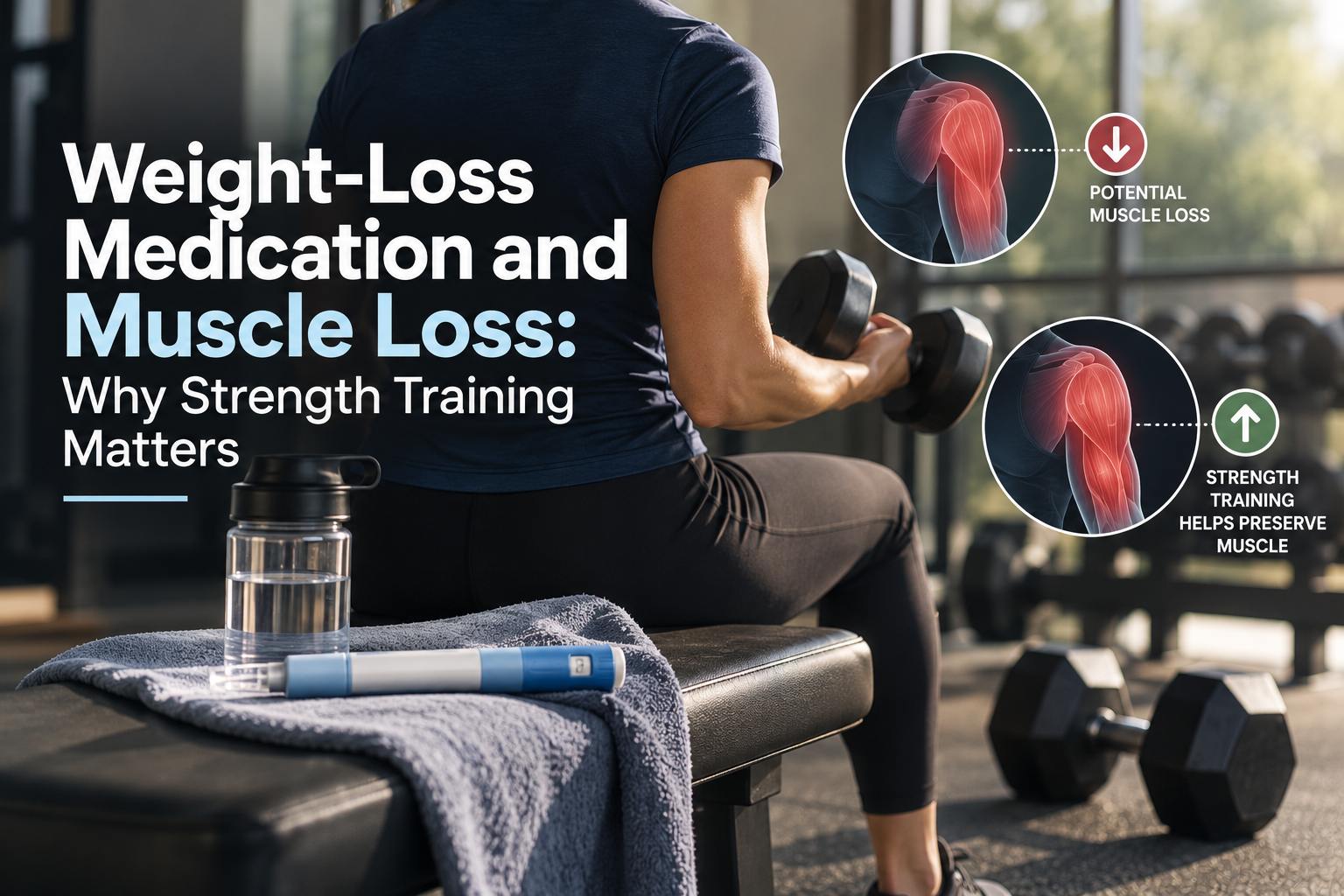
Use of GLP-1 medications for weight loss has grown sharply in Australia, and many people are seeing big changes on the scale. What the scale cannot show is what that weight is made of. When weight comes off quickly, some of it is fat and some of it is muscle. Muscle keeps you strong, steady on your feet and able to keep doing the things you enjoy, so protecting it matters.
At The Physio Crew, our physiotherapists build strength programs around your body, including when pain or injury has held you back. This guide explains why muscle matters and how we can help at our Tullamarine, Carlton and Keilor clinics.
Quick answer: Losing weight can reduce muscle as well as fat, and research suggests the muscle share may be larger with GLP-1 medications. Progressive strength training is the main strategy experts recommend to help protect muscle. Australian guidelines recommend muscle-strengthening activity on at least two days each week for adults aged 18 to 64. A physiotherapist can help you start safely, work around pain or injury, and track your strength over time. Decisions about your medication stay with your GP or prescriber.
What happens to muscle when weight comes off
When your body is in an energy deficit, it draws on fat and on lean tissue, including muscle. How much comes from each varies between people and between studies. At AUSactive’s Active Australia Summit in Canberra on 11 August 2026, systematic reviews were presented suggesting that around a quarter of the weight lost through weight loss in general is muscle, and that the share can be as high as 45% with GLP-1 medications. Because estimates differ between studies, the safest takeaway is that a meaningful share of lost weight can be lean mass, and it is worth planning for.
This matters because muscle supports far more than appearance. A Deakin University study reported in June 2026 found that people using GLP-1 medications without exercise risk losing lean muscle mass, strength and bone density. These are factors linked to falls, fractures and other health problems.
What Australian experts are saying
AUSactive chief executive Ken Griffin has argued that exercise is the safety net that protects muscle and bone for people using these medications.
Deakin University’s Professor David Scott presented a survey of just under 750 Australian GLP-1 users at the August summit. Average self-reported weight loss was close to 15 kg, yet only about 40% said a health professional had discussed muscle health with them at the start of treatment.
Strength training is already under-done nationally. Victoria’s Better Health Channel, citing AusPlay and Australian Bureau of Statistics data, reports that about 28% of Australian adults meet the guideline of strength activity on two or more days a week, and more than two thirds do no strength-based activity.
Who should pay particular attention
Anyone losing weight quickly, whatever the method.
Older adults, where lost strength and balance raise the stakes of a fall.
Women in midlife and perimenopause, when bone health is already a concern. Fitness educator Mish Wright has noted that osteopenia and osteoporosis are major issues for women, and that many only find out after a fall.
People with painful shoulders, knees, hips or backs who have been avoiding training.
How a physiotherapist can help
Starting strength training can feel daunting, especially if you have not trained for years or pain has held you back. A physiotherapist can make the first steps safer and more effective.
Assess. We check your strength, balance, movement and any pain, so your program starts at the right level.
Build around your body. If a shoulder, knee or back problem has made training difficult, we adjust exercises and loads so you can keep progressing.
Measure. Where appropriate, objective testing such as VALD assessment can show strength and force output and be repeated to track change. See our guide to VALD assessment for how it works.
Progress. We coach technique and increase the load step by step so the program keeps challenging you without overloading you.
Strength and conditioning support. The Physio Crew offers rehabilitation gym access for patients on an active program and clinical small group exercise classes to help you build strength with guidance.
Work with your care team. Physiotherapists do not prescribe or adjust medication or set diet plans. Your GP or prescriber manages the medication, and an accredited practising dietitian can advise on protein and nutrition.
Where to start with strength training
Your program should be built around you, but the general principles are simple.
Aim for muscle-strengthening activity on at least two days each week, as the Australian guidelines recommend for adults aged 18 to 64. Older adults should ask for an individual plan.
Cover the big movement patterns: squatting or sitting to standing, stepping up, hinging at the hips, pushing, pulling and carrying.
Start with a weight you can control for around 8 to 12 repetitions, then add load or repetitions gradually as it gets easier.
You do not need a gym. Body weight, resistance bands and household items can all work.
Leave a day between sessions that train the same muscles, and expect some muscle soreness early on.
Many people using these medications report side effects such as nausea or tiredness. On low-energy days a shorter, lighter session still counts, and any side effects are worth raising with your GP.
When to stop and get checked
Stop exercising and seek medical help promptly if you experience chest pain, fainting, severe dizziness or unusual breathlessness. See a physiotherapist if joint pain is new, getting worse over several days, or stopping you from training.
Start with a strength plan that suits your body
If you are using weight-loss medication, or thinking about it, and want a safe way to protect your muscle, a physiotherapy assessment is a practical first step. The Physio Crew is a sports and musculoskeletal physiotherapy practice with clinics in Tullamarine, Carlton and Keilor. Our physiotherapists are registered with AHPRA and use evidence-based assessment and rehabilitation.
All three clinics use VALD force plate and dynamometry equipment to measure strength, balance and movement. We explain your results at testing and repeat them through your program so you can see change over time.
Ready to protect your muscle? Book a physiotherapy assessment online at www.thephysiocrew.com.au/book or call your nearest clinic. Clinic details are below.
Book your appointment and contact us
Booking takes a few minutes. Go to www.thephysiocrew.com.au/book, then choose your preferred clinic, date, time and practitioner. You can also call or email the clinic nearest you.
Physiotherapy Tullamarine
Address: Unit 1, 191 Melrose Drive, Tullamarine VIC 3043
Phone: 03 9116 8691
Email: admin@thephysiocrew.com.au
Serving: Tullamarine, Gladstone Park, Westmeadows, Airport West and Greenvale. Free on-site parking.
Physiotherapy Carlton
Address: Unit 2, 221 Drummond Street, Carlton VIC 3053
Phone: 03 9116 8693
Email: carlton@thephysiocrew.com.au
Serving: Carlton, Parkville, Fitzroy, North Melbourne and Brunswick. Walking distance from the University of Melbourne.
Physiotherapy Keilor
Address: 53 Willys Avenue, Keilor Downs VIC 3038
Phone: 03 9116 8694
Email: kd@thephysiocrew.com.au
Serving: Keilor, Sydenham, Taylors Lakes, St Albans and Hillside.
Follow The Physio Crew on Instagram and Facebook at @thephysiocrewofficial for more strength and injury prevention tips.
Strength starts with the first session. Book online at www.thephysiocrew.com.au/book or call Tullamarine on 03 9116 8691, Carlton on 03 9116 8693 or Keilor on 03 9116 8694.
Frequently Asked Questions
Do weight-loss medications cause muscle loss?
Weight loss itself can reduce muscle as well as fat, and research suggests the muscle share of lost weight may be higher with GLP-1 medications. Strength training is the main strategy experts recommend to help protect muscle.
How often should I do strength training while using GLP-1 medication?
Australian guidelines recommend muscle-strengthening activity on at least two days each week for adults aged 18 to 64. A physiotherapist can tailor the exact plan to your health, goals and any pain or injury.
Is it safe to start strength training if I have not exercised for years?
For most people, yes, when it is built up gradually. If you have a health condition or any concerns, speak with your GP first. A physiotherapist can then set a starting level that suits you.
Can a physiotherapist help if I have joint pain?
Yes. A physiotherapist can adjust exercises and loads around a painful shoulder, knee, hip or back so you can keep building strength safely.
Do I need a gym to protect my muscle?
No. Body weight, resistance bands and household items can all be used for strength training. What matters is that the load increases gradually over time.
Will seeing a physiotherapist change my medication?
No. Physiotherapists do not prescribe or adjust medication. Your GP or prescriber manages your medication, and a physiotherapist designs the exercise side of your plan.
Where can I see a physiotherapist for a strength program in Melbourne?
The Physio Crew has physiotherapy clinics in Tullamarine, Carlton and Keilor Downs. Our physiotherapists assess your strength, balance and movement and build a progressive strength program around your body and any pain or injury.
How do I book a physiotherapy appointment at The Physio Crew?
Book online at www.thephysiocrew.com.au/book by choosing your clinic, date, time and practitioner. You can also call Tullamarine on 03 9116 8691, Carlton on 03 9116 8693 or Keilor on 03 9116 8694.
This article is general information only and is not a substitute for individual medical advice. Speak with your GP or health professional about your own situation.