
VALD Assessment for Surgery Recovery and Sports Injuries Who Is It For?
Introduction
One of the most common questions we get about VALD at The Physio Crew is: Is this just for elite athletes?
The answer is no. Not even close.
The same technology that helps an AFL footballer assess ACL readiness is equally valuable for a 55-year-old recovering from a total knee replacement, a runner who keeps breaking down on the same side, or a tradie returning to work after a shoulder repair.
Here is exactly who benefits from VALD assessment and why.
Athletes and Active People
For athletes and active patients, VALD is most commonly used to assess return-to-sport readiness, identify strength asymmetries before they cause injury, benchmark performance at the start of a training block and monitor the true results of a strength and conditioning program. Not how training feels — but what it is actually producing in measurable numbers.
Strength asymmetries are one of the leading causes of sporting injuries and re-injuries. A deficit of 15 to 20% between sides is often completely asymptomatic. The athlete feels fine, trains hard and then breaks down because the underlying imbalance was never addressed. VALD identifies these deficits before they become injuries.
At The Physio Crew we work with athletes from local sporting clubs across Tullamarine, Carlton and the western and northern suburbs of Melbourne, from junior footballers and netballers to competitive runners and gym athletes. VALD gives every one of them access to the same assessment standard as an AFL club.
Post-Operative Patients
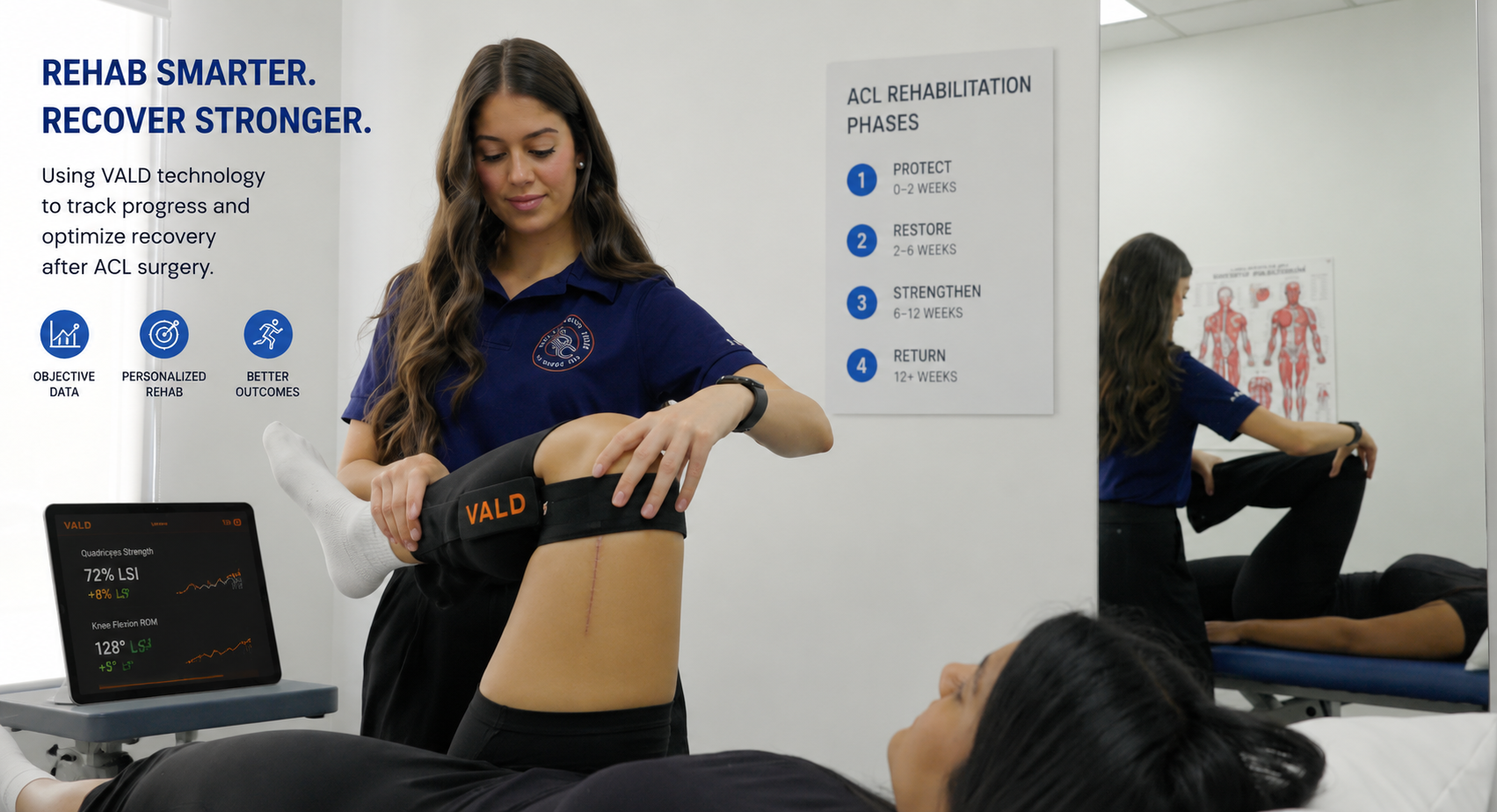
Post-operative patients benefit enormously from VALD assessment. After surgery the critical question is always whether your body is actually recovering the way it should. VALD provides objective milestones throughout rehabilitation rather than basing decisions on how a patient feels or how many weeks post-surgery they are.
After ACL Reconstruction
Return-to-sport decisions have historically been made based on time — usually 9 to 12 months — and subjective clinical impression. Research now shows that strength symmetry, specifically the operated leg producing at least 90% of the force of the unaffected leg, is a far more reliable indicator of re-injury risk. VALD ForceDecks and DynaMo measure this directly so your physio can tell you with confidence when you are genuinely ready to return.
ACL re-injury rates drop significantly when return-to-sport decisions are guided by strength data rather than time alone.
After Total Knee Replacement
Quadriceps strength loss is one of the most under-appreciated outcomes of knee replacement surgery. Studies show significant quad weakness persists for months to years in many patients. VALD allows your physio to quantify this deficit and track whether your rehabilitation program is actually addressing it, giving you objective evidence of real progress at every stage of recovery.
After Hip Replacement
Hip abductor and gluteal weakness following hip replacement is a major contributor to ongoing gait problems and falls risk, particularly in older patients. VALD strength testing identifies these deficits precisely and tracks whether rehabilitation is effectively addressing them throughout recovery.
After Rotator Cuff Repair
Shoulder strength asymmetries following rotator cuff repair are common and often persist well beyond the point at which a patient reports feeling normal. VALD dynamometry quantifies exactly how much shoulder strength has been recovered and how much remains to be rebuilt before full function is restored.
WorkCover and TAC Patients
For WorkCover and TAC patients, VALD provides objective strength and function data that guides the rehabilitation program and, where required, provides measurable evidence of functional capacity and progress toward return to work. Objective data is far more useful than subjective reports in a WorkCover or TAC context, both for your treating team and for your insurer.
Anyone Who Wants to Move Better
Even without an injury, anyone who wants a deeper understanding of how their body functions can benefit from a VALD performance screening. If you are a gym athlete wondering why one side always feels weaker, a runner trying to understand recurring injuries, or someone who simply wants a data-driven picture of their movement and strength, VALD provides answers that a standard consultation often cannot.
Think of it as a deep-dive fitness check that goes far beyond anything available at a standard gym assessment.
Why The Physio Crew for VALD in Melbourne?
VALD technology is still relatively uncommon in private physiotherapy clinics across Melbourne. At The Physio Crew, VALD assessment is available across our Tullamarine, Carlton and Keilor Downs clinics and is fully integrated into our rehabilitation and gym-based recovery services.
Your VALD data does not just produce a report. It directly shapes the hands-on treatment and structured rehabilitation program your physio designs for you. The assessment and the rehabilitation happen under the same roof with the same team.
We treat elite local athletes, patients recovering from major orthopaedic surgery, workers in WorkCover and TAC rehabilitation, and anyone seeking a precise, data-driven understanding of how their body functions.
Better data leads to better outcomes. That is the principle behind everything we do.
Frequently Asked Questions
Do I need to be injured to have a VALD assessment?
Not at all. Many patients come in for a VALD performance screening with no current injury, simply to identify weaknesses and asymmetries before they become a problem.
How often should I have a VALD assessment?
For rehabilitation patients, repeat testing every 4 to 6 weeks provides a clear picture of progress. For performance athletes, pre-season screening and mid-season check-ins are common. Your physio will recommend the right frequency for your goals.
Is VALD safe?
Absolutely. The tests involve natural movements like squats, jumps, balance tasks and gentle resistance testing. There are no invasive procedures, no electrical stimulation and no discomfort beyond normal physical exertion. If you have specific limitations your physio will modify the tests accordingly.
How is VALD different from a regular physio assessment?
A standard physiotherapy assessment uses clinical observation, manual testing and patient-reported symptoms. These are valuable but qualitative. VALD adds precise numbers to what a physio can already observe, enabling more accurate diagnosis, clearer rehabilitation targets and objective progress tracking over time.
Is VALD available at all The Physio Crew clinics?
Yes. VALD technology is available at our Tullamarine, Carlton and Keilor Downs clinics. All three locations offer the same standard of VALD assessment and rehabilitation.
Book a VALD Assessment at The Physio Crew
We are currently accepting new patients at our Tullamarine, Carlton and Keilor Downs clinics with online bookings available now.
Book online at thephysiocrew.com.au
Your recovery deserves more than a guess. Book your VALD assessment today.